The Payup Calculator. Illustrative.
The Payup Calculator
A committee asks two questions about a slow pool before any other: what is the speed story worth over the generic price, and what rate move erases it. This tool answers both from five inputs, with the working shown. Payup is what a hand picked pool earns over the generic price, quoted in points and 32nds, so 1-08 is one point and eight ticks. CPR is how fast borrowers prepay, annualised. Everything it returns is illustrative: a simple product of stated factors, not a model of any real pool, and not a price anyone will pay.
The calculator opens with the sample pool already computed. Change any input and the result recomputes.
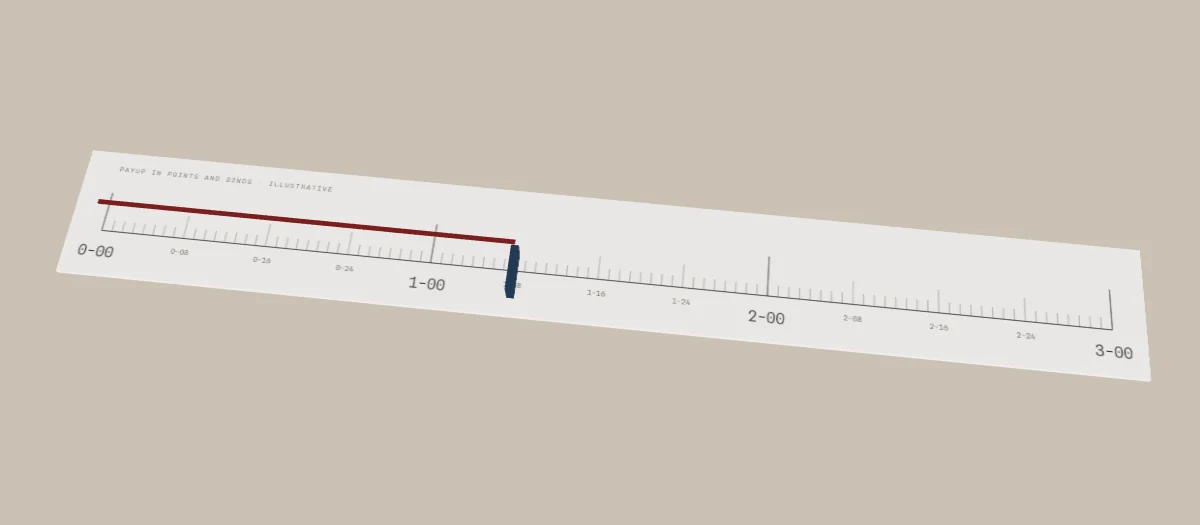
Illustrative payup
Payup, points and ticks (for example 1-08)
In decimal points (for example 1.250)
Speed gap: 7.4 against 10.3, a gap of 2.9 CPR.
What would break it: a rally of about 48 bp.
The size of rate rally, in basis points, that would close the speed gap under the illustrative sensitivity used here. Not a forecast of rates.
No payup case. This pool is not printing slower than its cohort.
A payup needs a speed gap. With the pool at or above its cohort there is nothing for the price to reward.
Illustrative. Smart Augment publishes research. Nothing here is investment advice and model output is an estimate.
Research outputs for the customer's own investment professionals. Not a recommendation, an offer or a solicitation. Models are estimates. Figures derive from official agency disclosures and public market data.
How it is computed
Run log. Illustrative sensitivity. Not a model of any real pool.
- 01speed gap = cohort CPR minus pool CPR, floored at zero. A pool at or above its cohort has no gap and no case.
- 02carry = coupon minus 4.0, floored at 0.25. A higher coupon has more carry for a slower speed to protect.
- 03balance factor = 1.30 under $85k, 1.15 from $85k to $125k, 1.00 from $125k to $175k, 0.85 over $175k.
- 04horizon factor = 0.80 at 6 months, 1.00 at 12 months, 1.15 at 24 months.
- 05payup in ticks = speed gap x carry x 8.0 x balance factor x horizon factor, rounded, capped at 96 ticks (three points).
- 06rendered as points and 32nds, so 40 ticks prints as 1-08 and as 1.250 in decimal.
- 07what would break it = speed gap divided by 0.06, rounded, in basis points of rally. A 2.9 CPR gap gives about 48 bp.
- 08every factor above is a stated assumption, not a fitted parameter. Change one and the result changes with it, which is the point.

Payup is quoted in 32nds. A steel rule at macro. Sample photograph.