RESEARCH
$0per month
Billing: none. No card on file.
Two gated reports a month, the daily and weekly macro, and the rate and housing dashboard. No card, no clock, and no one calls you.
Research note. September 2026. From disclosure file to committee memo.
A research desk for agency mortgage bond investors.
Smart Augment pulls the monthly agency disclosure files, screens the pool universe, models prepayments against your own rate paths and writes the committee memo, with the screen and the model run attached. Built for portfolio managers and analysts running agency mortgage bonds on a buy side desk.
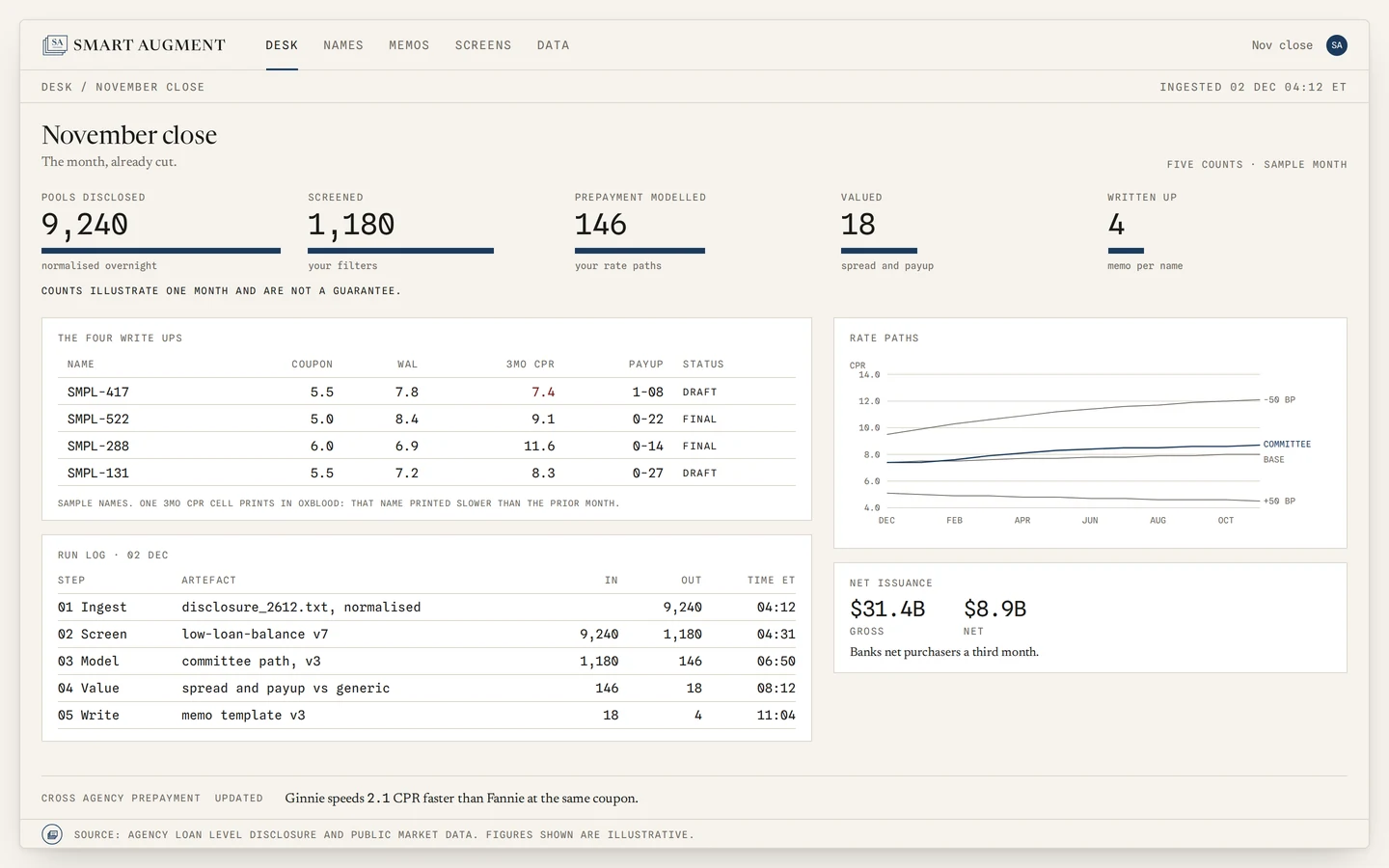
In a sample month the agencies disclose 9,2401. The desk screens them, models 1462 against your own rate paths, and writes 43 up with the screen and the run attached.
Counts illustrate one month and are not a guarantee.

9,240 rows in. Four pages out.
One monthly cycle, narrowing. The agency files land at month end and are normalised overnight. By the second business day, counted from the moment the file posts, four write ups and the trail behind them are on the desk. The trail is the point: every count below is a row you can open.
| Footnote | Stage | Count | What it is |
|---|---|---|---|
| 1 | POOLS DISCLOSED | 9,240 | Agency month end loan-level files, normalised overnight |
| SCREENED | 1,180 | Your filters on balance, geography, score and servicer | |
| 2 | PREPAYMENT MODELLED | 146 | Speeds run against your rate paths, not a default |
| VALUED | 18 | Spread and payup against the generic price | |
| 3 | WRITTEN UP | 4 | A memo per name, with the run attached |
Counts illustrate one month and are not a guarantee.
Payup is what a hand picked pool earns over the generic price. CPR is how fast borrowers prepay, annualised.
What would break it: a month in which the agency files post late. The cycle starts when the file does, and it cannot start before.
Research outputs for the customer's own investment professionals. Not a recommendation, an offer or a solicitation. Models are estimates. Figures derive from official agency disclosures and public market data.
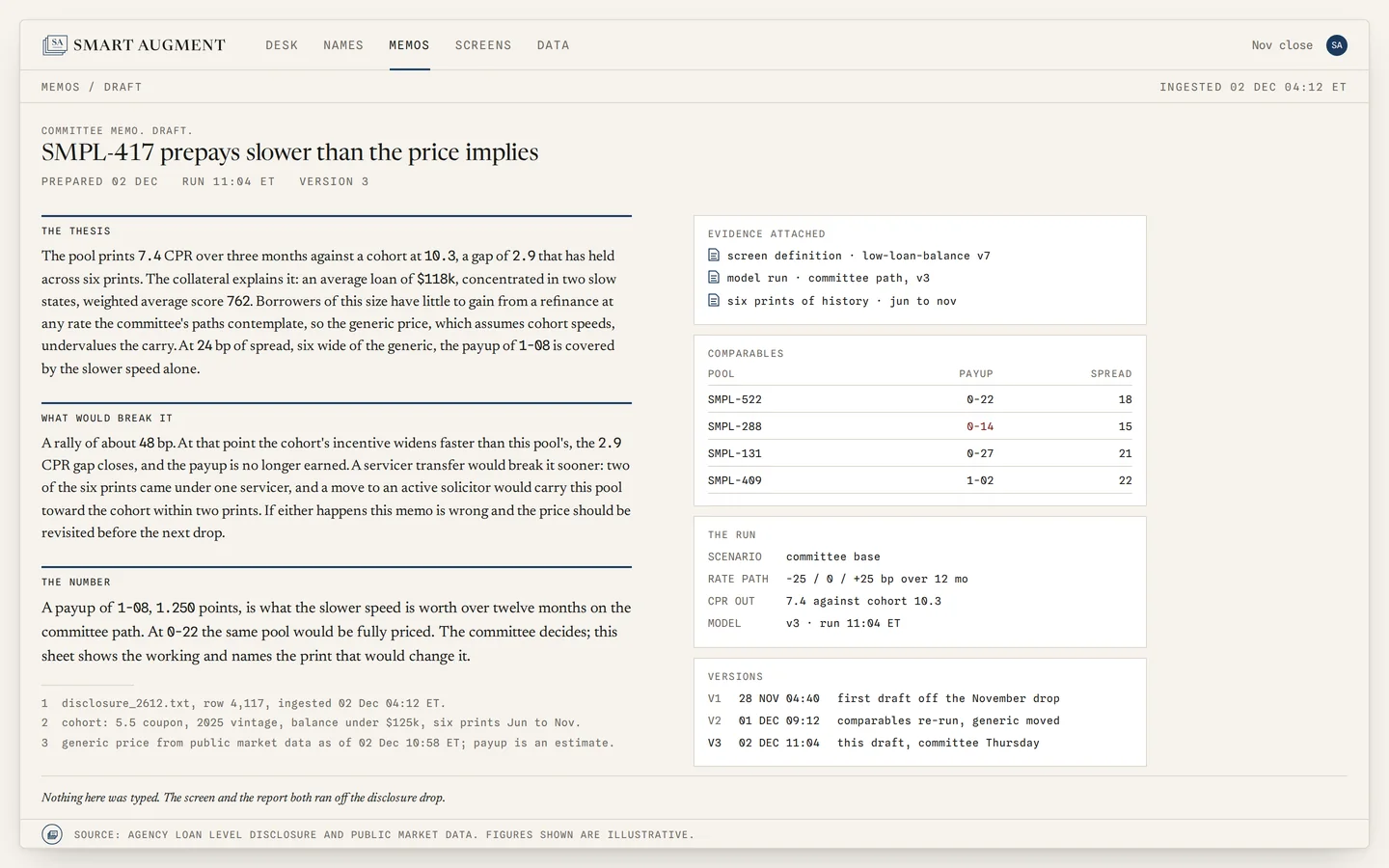
Three screens carry the whole cycle. One shows the month already cut, one shows a single pool with its behaviour and its price on the same sheet, and one is the memo, assembled rather than retyped. All figures in the screens are sample data and are labelled as such inside the product.
Idle. The three screens in one panChoose a tab to keep one screen still. The pan runs across the same shell three times: the desk, the name, the memo.
Tab 1, The DeskThe month, already cut. 9,240 pools disclosed, 146 modelled, 4 written, with the four write ups in one table and the rate paths beside them. Counts illustrate one month and are not a guarantee. The cross agency line at the foot is rebuilt from both agencies' files each month: in the sample month, Ginnie speeds 2.1 CPR faster than Fannie at the same coupon.
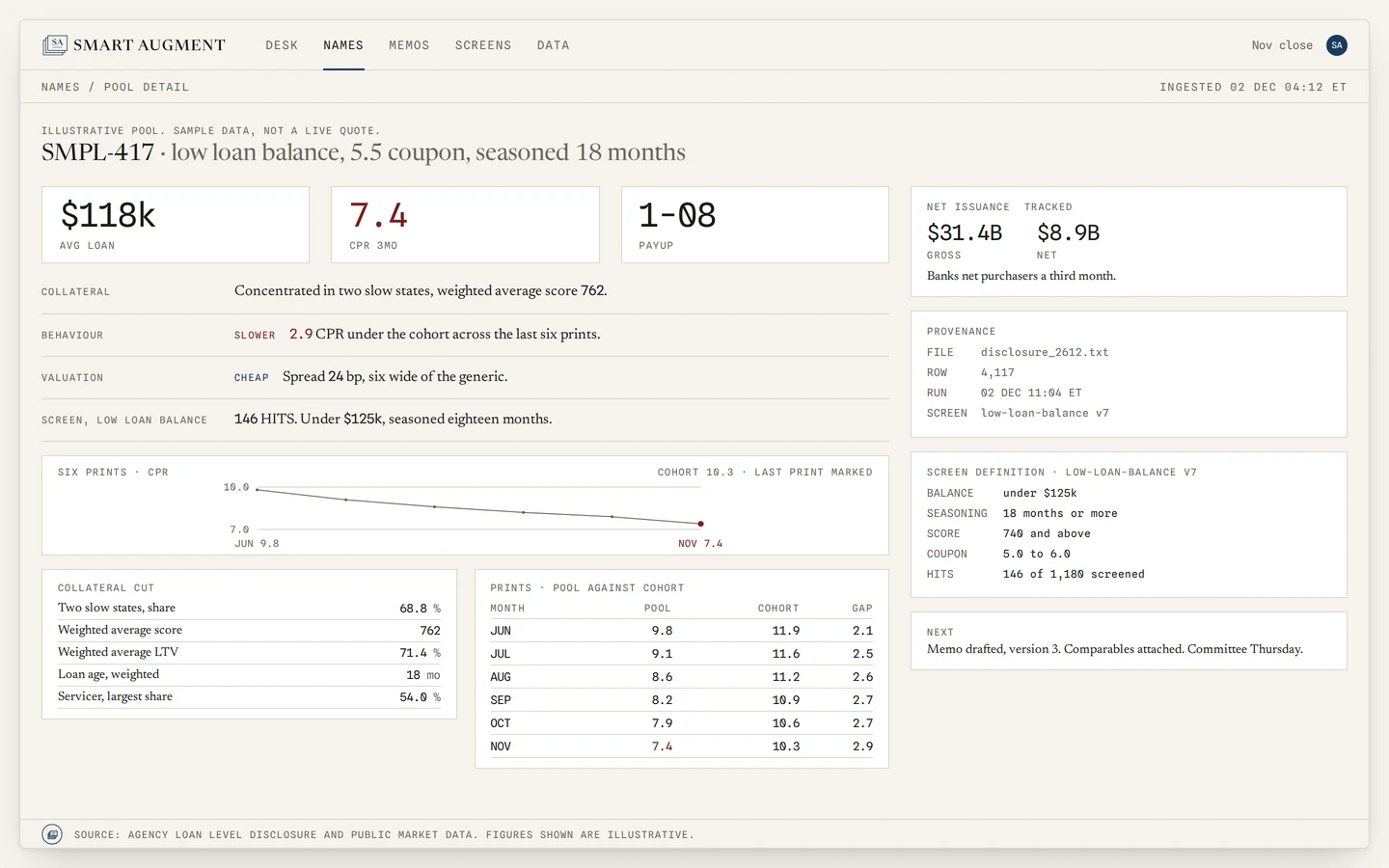
Tab 2, The NameOne pool on one sheet. Sample data, not a live quote: $118k average loan, 7.4 CPR over three months, a 1-08 payup. Collateral concentrated in two slow states with a weighted average score of 762. Behaviour 2.9 CPR under the cohort across six prints. Valuation a spread of 24 bp, six wide of the generic, which is the figure behind the tag beside it. The low loan balance screen that surfaced it returned 146 hits: under $125k, seasoned eighteen months.
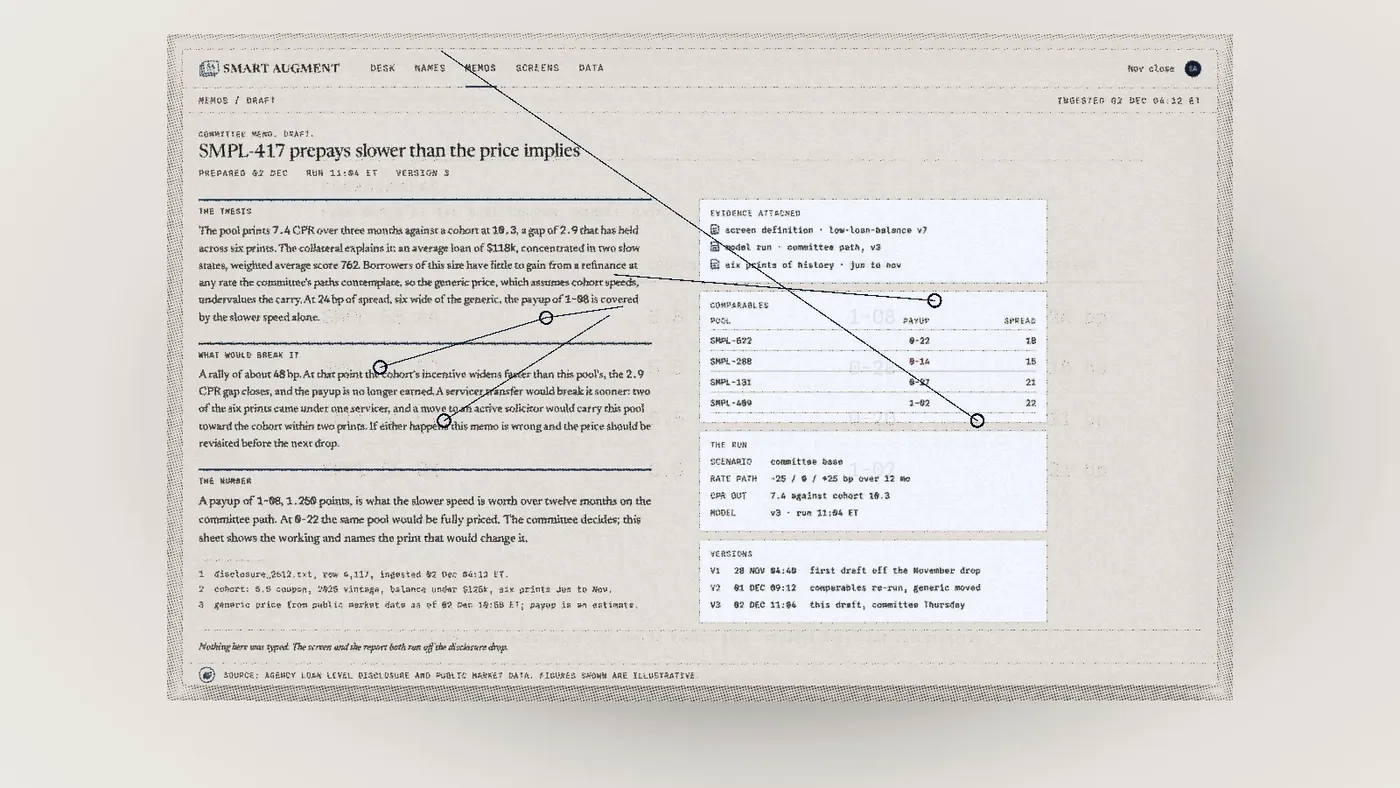
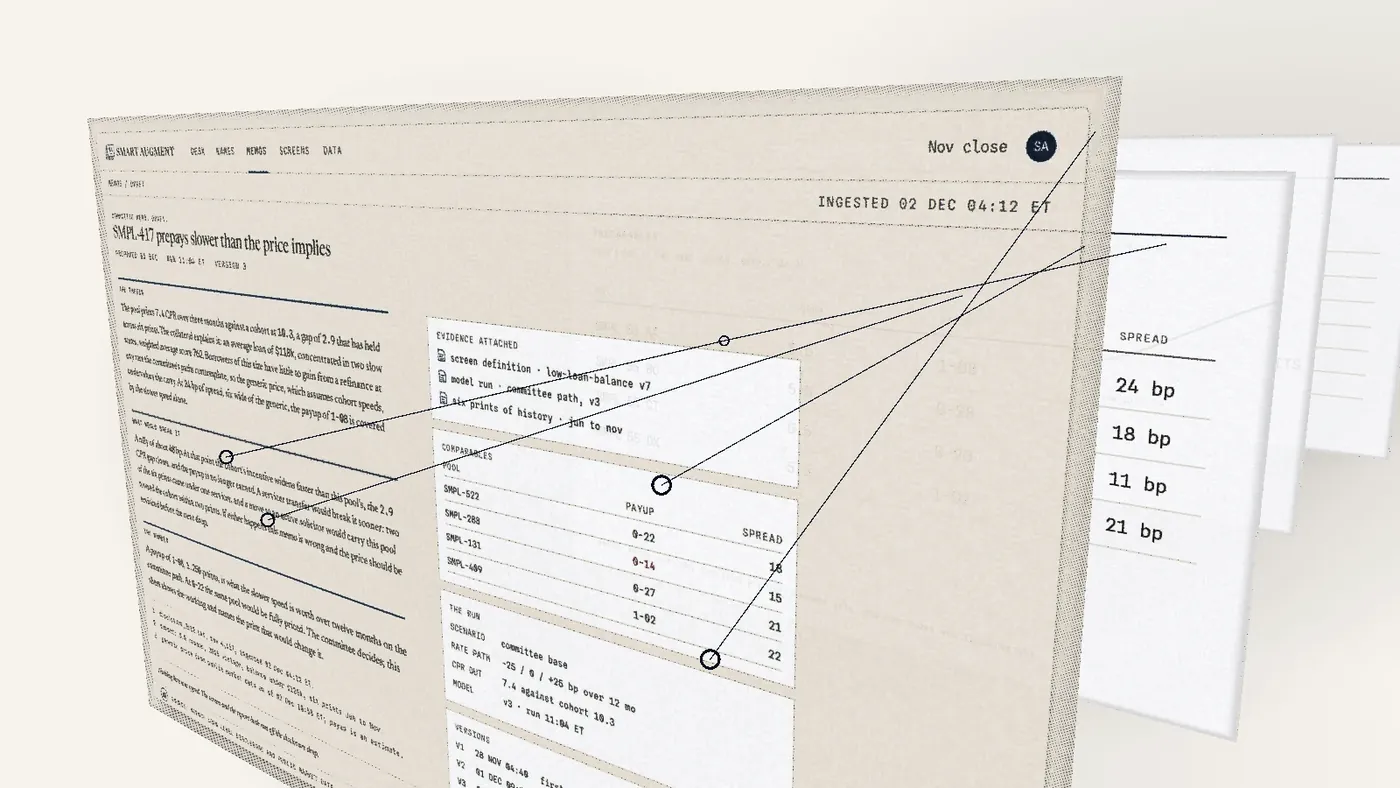
Tab 3, The MemoThe deliverable. A one paragraph thesis on why the pool prepays slower than the price implies, the evidence attached (screen definition, model run, six prints of history), four comparables and where they trade, and a paragraph headed What would break it that names the rate move making the payup wrong. Nothing here was typed. The screen and the report both ran off the disclosure drop.
SOURCE: AGENCY LOAN-LEVEL DISCLOSURE AND PUBLIC MARKET DATA. FIGURES SHOWN ARE ILLUSTRATIVE.
Smart Augment publishes research. Nothing here is investment advice and model output is an estimate.
The same three questions on every name, answered the same way every month. What would break it: a question the committee asks that the memo did not. Tell us and it goes in next month's template.
Research outputs for the customer's own investment professionals. Not a recommendation, an offer or a solicitation. Models are estimates. Figures derive from official agency disclosures and public market data.
The loan-level files are ingested overnight, normalised into one schema, and stamped with the file, the row and the time. The cycle starts with data on the second business day rather than with a download queue on the fourth. Nobody on the desk touches a file.
The screen you cut by hand every month runs itself, and it is versioned. November's screen is October's screen unless someone changes it, and the change is logged with a name and a date. When the committee asks why a pool dropped out, the answer is a diff, not a memory.
Speeds are modelled against the scenarios your committee actually argues about, three or four of them per pool, with the path named on the output. A vendor default rate path answers a question nobody at your table asked. The run shows which path produced which CPR.
Each name gets a write up with the screen definition, the model run, six prints of history and four comparables attached to it, plus a What would break it paragraph. The memo is not a summary of the work. It is the work, in the order a committee reads it.
A research seat on a market data terminal is reported at roughly $25,000 a year. Platform is $12,000. Desk is $200 a user a month. The price is set against the seat this replaces for a research workflow, and it is printed here rather than quoted on a call.

What would break it: a desk whose edge is the rate path rather than the screen. For that desk the saving is the clerical hours, which are still most of the hours.
Every memo ends with the rate move that makes it wrong. On the sample pool it is a rally of about 48 bp. If that number is not on the page, the case has not been made.
From the memo template. Sample figure.
A committee does not fund a thesis. It funds a thesis it has tried to break and could not. So the hedge goes before the conclusion, in the same type size, on every name, every month. The figure is illustrative and the model that produces it is an estimate, which is exactly why it is shown with its inputs.
Research outputs for the customer's own investment professionals. Not a recommendation, an offer or a solicitation. Models are estimates. Figures derive from official agency disclosures and public market data.
Three plans, each priced per named user, each with its full cost printed before anything enters the cart. Prices are in US dollars and exclude state sales tax where it applies. There is no setup fee, no per report charge and no overage.
$0per month
Billing: none. No card on file.
Two gated reports a month, the daily and weekly macro, and the rate and housing dashboard. No card, no clock, and no one calls you.
$200per named user per month
Billed monthly. Cancel whenever you like; access runs to the end of the month you paid for.
Everything in Research, plus the full report archive, a builder for your own report, scheduled delivery, and a question box that answers out of the ingested disclosure data.
Total: $200.00 a month for 1 named user
$1,000per named user per month
$12,000Billed annually. $12,000 per named user per year, charged today.
Everything in Desk, plus screening on the whole disclosed universe, prepayment and valuation models run on your own rate scenarios, and committee memo export with the screen and the run attached.
Total: $12,000.00 today for 1 named user, 12 month term
See the full seat math and the cancellation rules on the pricing page.
What would break it: a price you find somewhere on this site that is not on this card. Tell support@smartaugment.com and it is fixed the same day.
On the plan card, with the stepper, before anything goes into the cart. The total beneath it updates as you change it, and the same total appears again in the cart and on the checkout summary. Seats are not edited inside checkout; a Change seats link takes you back to the cart.
Annually, at $12,000 per named user per year, charged today for a 12 month term. The monthly figure of $1,000 is the same number divided by twelve, and both figures are printed at the same weight everywhere on this site.
Monthly, at $200 per named user per month, charged on the day you order and on the same day each month after. A seat added mid month is prorated across the days left in the month and appears on the next invoice.
Yes, at any time, in two steps: Billing, then Cancel plan, then one confirm. Or email support@smartaugment.com, which is also accepted. Cancellation takes effect at the end of the period already paid for. Desk runs to the end of the current month. Platform runs to the end of the current 12 month term. Access is not cut off on the day you cancel.
Platform carries a 14 day full refund window from the first annual charge. After 14 days the term runs to its end. Desk is not refunded for a partial month, and access runs to the end of that month. Research has nothing to refund.
Yes. The renewal date and the exact renewal amount are on the plan card, in the cart, on the checkout summary, on your order confirmation and in your account. Platform subscribers receive a renewal notice 30 days before the annual charge by email, and by SMS if they opted in.
Neither is required to order. Checkout is guest checkout on every plan, and you are offered a password only after the order exists, with a Skip this option of equal weight. Research takes no card at all: nothing is charged and no card is stored. Desk and Platform take a card at checkout.
What would break it: a rule on this page that the Terms contradict. The Terms carry the same rules in the same words. If you find a difference, the more generous reading applies and we correct the other.