September 2026. Research note. Sample figures throughout.
The Six Prints
One monthly prepayment print is close to a coin flip. Six against the cohort start to describe a borrower base.
Reading time line: About 5 minutes.Sample figures throughout
A prepayment print is one number a month, and a pool gets exactly one. Most of the mistakes a committee makes about a pool come from treating that number as a fact about borrowers when it is a fact about one month. This note is about how many months it takes before a series stops being weather and starts being climate.
What a print actually is
Each month the agency publishes a new factor for every pool: the fraction of the original balance still outstanding. The change in that factor, after scheduled amortisation, is the month's prepayment. Expressed as a share of the balance it is the single monthly mortality, and annualised it is CPR, which is how fast borrowers prepay, annualised. A 7.4 CPR print says that if this month repeated twelve times, 7.4 percent of the balance would be gone by the end of the year.
That is all a print is. It comes from two public numbers, this month's factor and last month's, and anyone with both files can reproduce it to the decimal.
Why one print is noise
Take a pool of 400 loans of roughly equal size. One borrower pays off. That is 0.25 percent of the balance in a month, which annualises to about 3.0 CPR. One family moving for a job, one divorce, one inheritance used to clear a mortgage, and the print moves by three points. Two payoffs and it moves by six. A pool with 80 loans moves by about 15 CPR per payoff.
So a single print carries the signature of a handful of people who had a reason this month. It is not a borrower base. A print of 4.1 followed by a print of 11.2 is what a slow pool looks like when two people move house in the same month. The pool did not change. The month did.
There is a second source of noise that has nothing to do with sample size. Prepayments are seasonal. Housing turnover peaks in late spring and summer and troughs in winter, so a pool's own prints fall from July to December in most years without any change in the borrowers at all. Read a pool against itself across those months and you will see a calendar.
Six prints, read against the cohort
Here is one illustrative pool, a 5.5 coupon, against its cohort, meaning pools of the same agency, coupon and production year. Six months, June through November, three month CPR on the right.
Print
Pool CPR
Cohort CPR
Gap
Jun
5.6
8.9
3.3
Jul
6.9
9.4
2.5
Aug
7.3
10.2
2.9
Sep
7.0
10.0
3.0
Oct
8.1
10.9
2.8
Nov
7.1
10.0
2.9
Three month
7.4
10.3
2.9
Sample data, not a live quote.
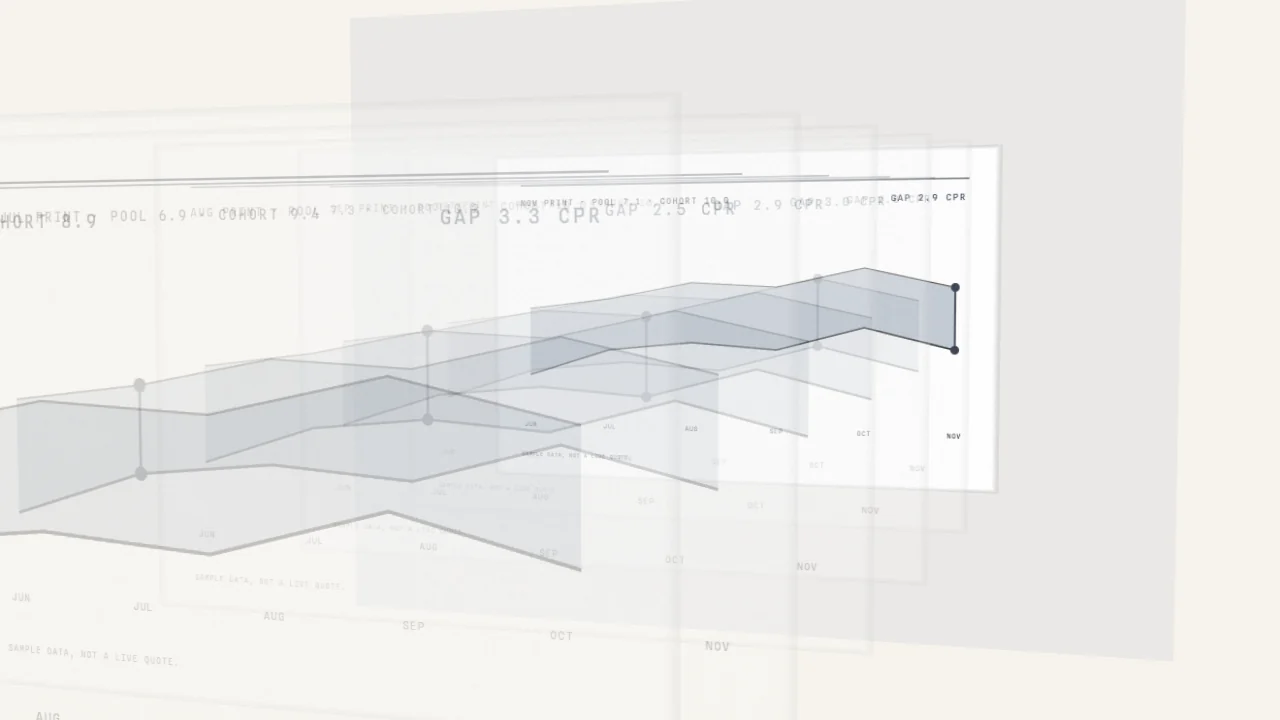
The gap holds steady. Pool 5.6 to 7.1, cohort 8.9 to 10.0, June to November.
Two things are visible that no single row could show. First, the pool has printed under its cohort six times out of six. If speed relative to the cohort were a coin flip each month, six of six has a probability of about 1.6 percent, and while months are not independent (these are the same borrowers every month), that dependence is the point. Persistence is what a borrower characteristic looks like in the data. Second, the gap is steady. It sits between 2.5 and 3.3 and averages 2.9. A gap that swung from 0.4 to 6.1 and happened to average 2.9 would tell you something about volatility and nothing about the borrowers.
Note also what the cohort column did for you. The pool's own prints rose from 5.6 to 8.1 and fell back, which read alone looks like a pool that sped up and slowed down. The cohort did the same thing. What was left after the comparison was the constant.
Six sheets, one per month. The cutting plane inks the passing print.
JUN · POOL 5.6 · COHORT 8.9 · GAP 3.3
JUL · POOL 6.9 · COHORT 9.4 · GAP 2.5
AUG · POOL 7.3 · COHORT 10.2 · GAP 2.9
SEP · POOL 7.0 · COHORT 10.0 · GAP 3.0
OCT · POOL 8.1 · COHORT 10.9 · GAP 2.8
NOV · POOL 7.1 · COHORT 10.0 · GAP 2.9
The cohort is the instrument, not the pool
The temptation is to admire the pool. Resist it. The information is in the difference, and the difference is only as good as the cohort. Match the agency, because Ginnie and Fannie pools at the same coupon prepay differently for reasons covered in another note. Match the coupon, because a 5.0 and a 6.0 face different refinancing incentives. Match the production year, because a pool seasoned eighteen months has passed the early ramp and a pool seasoned four has not. Weight the cohort by balance, not by pool count, or a few tiny pools will drag it around. And build it from the same disclosure files as the pool, on the same day, so the two are never a month out of step.
Get any of those wrong and the gap you measure is a fact about your cohort definition, and six prints of it is six prints of the same mistake.
What the series can carry, and what it cannot
Six sheets fanned on a desk, edges only. Sample photograph.
Six steady prints under the cohort, with a story behind them that the loan-level file supports (a low average balance, a concentration in slow states, a high weighted average credit score), will carry a payup case. Payup is what a hand picked pool earns over the generic price, and a 2.9 CPR gap on a 5.5 coupon is the kind of gap that has one. How large is worked in the balance note and in the calculator on this site.
What the series cannot carry is a forecast that survives a different rate regime. Six prints between June and November were six prints under one set of mortgage rates. They say how these borrowers behaved when the refinancing incentive was roughly what it was. They say nothing yet about what they do when it doubles.
What would break it
The reading breaks in three ways, and the memo should name all three. A rally is the first. Under the illustrative sensitivity used on this site, a 2.9 CPR gap closes with a rally of about 48 bp, because the slow borrowers get enough dollar incentive to move and the cohort has already moved. A composition change is the second: a servicing transfer, a run of curtailments, or a handful of large loans paying off can change what the pool is without any print looking strange on its own. A cohort error is the third and the most embarrassing, because it is entirely your own.
What would break it
Six prints are not proof. They are the minimum before the word pattern is allowed in the memo.
Smart Augment publishes research. This note is not investment advice, and model output is an estimate.
Research outputs for the customer's own investment professionals. Not a recommendation, an offer or a solicitation. Models are estimates. Figures derive from official agency disclosures and public market data.